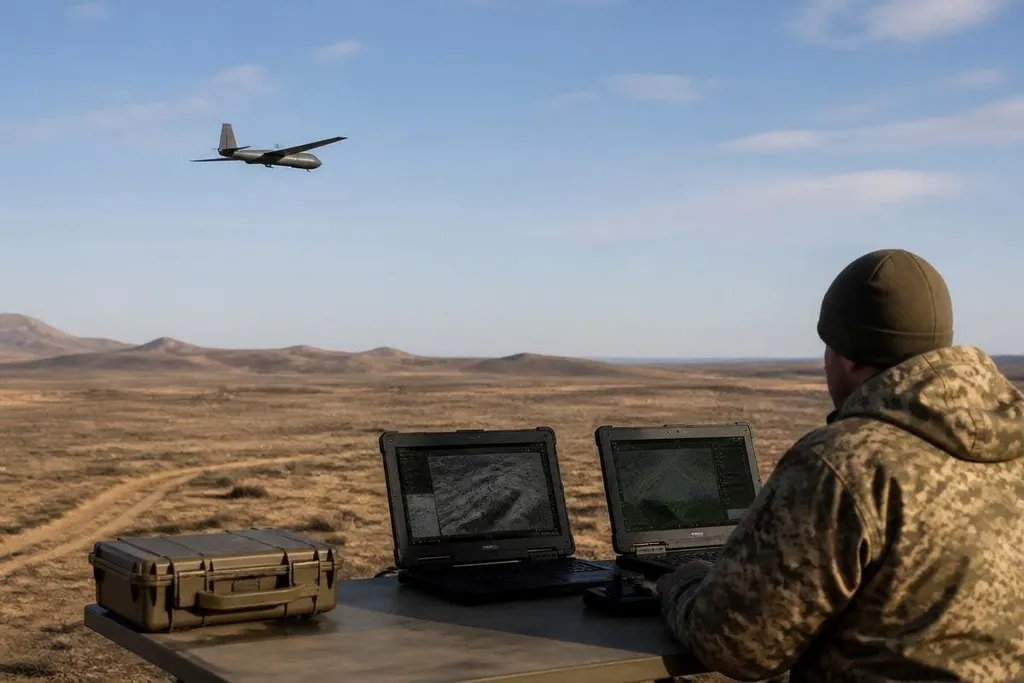
Autonomous defense drones can search, watch, and move with less direct control from a human operator. That helps explain their appeal, but no unit count, price, date, or named deployment was supplied here, so the size of this expansion cannot be measured honestly.
Quick read
- Autonomy can reduce the number of commands an operator sends during a flight.
- Cameras, thermal sensors, GPS, and radio links decide what the drone can do.
- Human approval, software limits, and clear records still matter before any field use.
Why defense teams want autonomy
A remotely controlled drone needs a person to guide its flight and react to changes. An autonomous drone can follow a planned route, hold its position, return to a launch point, or adjust its path when its sensors detect an obstacle.
That shift matters most when a single operator has several aircraft to watch. The operator can spend less time steering and more time checking sensor feeds, setting limits, and deciding what happens after the drone finds something.
Autonomy also helps when a radio link becomes weak. A drone that can keep a safe route or return home may avoid a simple loss of signal turning into a lost aircraft. This only works if the software behaves as tested in the same weather, terrain, and signal conditions.
The hardware sets the boundary
Software gets the attention, but the aircraft still depends on its physical parts. A daylight camera may show detail at long range, while a thermal camera can detect heat in darkness. GPS helps with position, and an inertial sensor measures motion when satellite signals are poor.
Each part adds weight, power use, and another possible failure. A larger battery can extend flight time, but it also adds mass. A stronger radio link can carry more data, yet it may reveal the drone's location or stop working near interference.
That is why an autonomy claim needs more than a video of a drone flying a route. The useful test asks how the system behaves after a sensor fails, a route changes, or the connection drops.
The human decision does not disappear
Autonomy can reduce manual control. It does not remove the need for rules, supervision, or a clear record of who made a decision.
A camera may identify a vehicle, but identification is not the same as knowing its purpose. A navigation system may reach a location, but reaching that location does not answer what the drone should do there. Those decisions need limits set before launch and a person who can stop the action.
Industry readers weighing autonomous defense drones can use Robot24.com robotics reporting to trace a company’s claim to the machine, test setting, date, and human control rule. Those details connect an autonomy claim to the logs and controls described next.
The hard part is proving that safeguards work outside a controlled demonstration. A system should record sensor inputs, operator commands, software decisions, and any point where a person took control.
What “expanding” should mean
The word can describe several different changes. A defense force may buy more aircraft, test autonomy on existing aircraft, add new software to a fleet, or move from a trial to regular use. Those are different stages, with different risks and costs.
A sound report should name the country or company, the drone model, and the number of aircraft. It should also give the purchase or test date and the task.
The report should say if the flight was supervised, if the video was edited, and what happened when the system faced an error.
I'd treat any expansion claim without those details as a plan, not proof of field use.
A practical check before judging a program
Use this list when reviewing a defense drone announcement:
- Name the aircraft: Check the model, size, battery, sensors, and stated flight time.
- Find the human role: Ask who watches the drone and who can stop its action.
- Check the test setting: Record the weather, terrain, radio conditions, and route length.
- Separate stages: Mark the difference between a lab test, field trial, purchase, and regular operation.
- Look for failure records: Find results from lost signals, blocked sensors, low battery, or software faults.
- Check the source: Prefer a dated contract, test report, official filing, or uncut flight record.
Those details show whether autonomy is reducing operator workload or moving more risk into software. They also tell you if a program is ready for repeated use, rather than ready only for a short demonstration.
The next useful measure is simple: for each named program, publish the drone model, aircraft count, test date, operator role, and failure result. Without those five facts, the size of autonomous defense drone growth remains an open question.